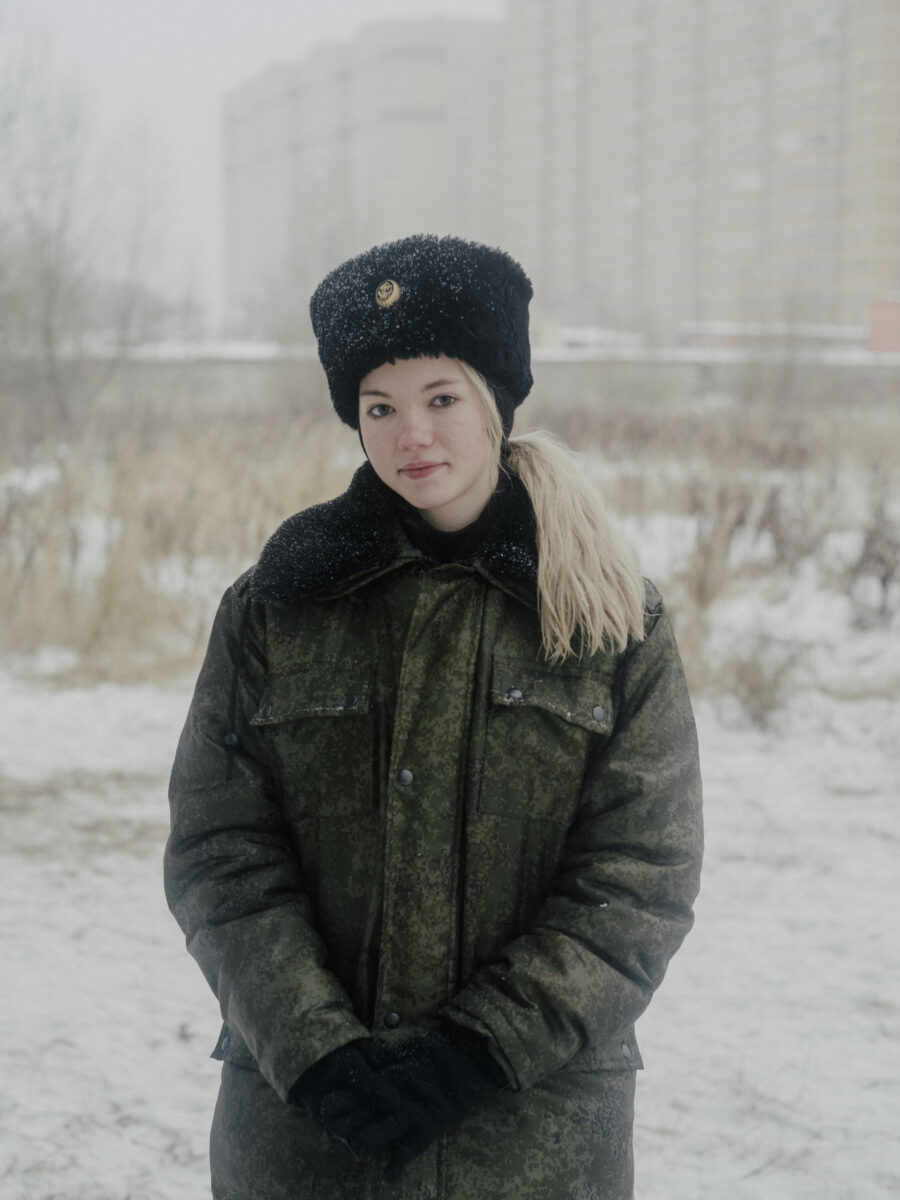
A militaristic nationalism, propagated from an early age, has become a foundation of President Vladimir V. Putin’s 24-year rule. Here, cadets who have just finished their studies are captured, fists clenched, in a state of fervid exaltation.
Police in Russia arrested thousands of people during a nationwide protest in January 2021 against the arrest of opposition leader Alexei A. Navalny.
Ukraine. Donbas. 24/02/2022 A Russian tank enters a region controlled by Moscow-backed rebels in eastern Ukraine on Feb. 24, 2022
A child in a miniature tank during the tank biathlon at the annual Army InternaAonal Games in the Moscow region. As the war in Ukraine continues, courses and extracurricular activities on military topics and Patriotism are being offered throughout Russia.
Fireworks at the military festival on Red Square. Little seems to have changed in everyday life in Moscow.
A military-historical reenactment in Samara for the „80th anniversary of the liberation of Kyiv“. A Soviet-era inheritance, the celebration of the Great Patriotic War is now manipulated by Vladimir Putin to gain public support for the conflict in Ukraine that “once again a real war has been unleashed on our motherland.“
A woman in the destroyed city center of Mariupol. It is estimated that 95% of the city was destroyed in the fighting. In Russian-occupied Mariupol, only about 150,000 residents remain. The Associated Press cites at least 10,300 new graves in and around Mariupol.
Sea of Crosses Signals War’s True Toll. A dismal, snowy plot near the Black Sea, on the outskirts of Bakinskaya, is the final resting place for soldiers from the Wagner mercenary forces, a testament to the huge casualties Russia is suffering in its invasion.
A Ukrainian man from the Luhansk region – conscripted to fight for Russian-backed separatist forces. A UN report on human rights in Ukraine states that after the invasion, Russian military conscription efforts included the occupied regions, subjecting young men to armed service against their own country.
If recruitment billboards overwhelmingly portray white Russian military heroes, the reality of Russia’s Ukraine war is of suffering and loss among minorities in poor villages, recruited at all ages and dying anonymously. Here, family and friends gather in Ovsyanka, a former collective farm in southwest Russian, to mourn Tunguz Kadyrov, 49, a Muslim and ethnic Kazakh killed after a few months in Ukraine.
Russia guards its secrets. Hundreds of police officers and National Guard troops surround the Porokhovskoye Cemetery in St. Petersburg, where Yevgeny V. Prigozhin, the Wagner military boss turned mutineer, was buried six days after his plane fell from the sky, and two months after his brief uprising against Putin’s conduct of the war.
For these Russian boys, Stalin is the greatest of leaders, his gulag notwithstanding. They pose outside the Kremlin walls, their proud expressions testimony to Putin’s rehabilitation of Stalin as the paramount symbol of Russian might and heroism.
The Arctic front in World War II is commemorated by the so-called Alyosha Monument in Murmansk. The scene seems to encapsulate at once the patriotic ardor and the isolating fracture of Putin’s Russia, frozen in time almost a quarter-century into his rule.
Patriarch Kirill I, the leader of the Russian Orthodox Church has called the invasion a righteous fight, casting the war as a holy struggle to protect Russia from what he called Western scourges like gay pride parades. He has been a vocal supporter of President Vladimir V. Putin, with the church receiving vast financial resources in return.
Volunteers from Chechnya, which a generation ago fought an unsuccessful war to secede from Russia, board an IL-76 transport plane in Grozny to fight in Ukraine, whose independence Putin refuses to accept. Monthly salaries of over $2,000 are a big draw. “The entire country is tangled in debt and money is the primary motivator,” said one former Wagner mercenary boarding the flight.